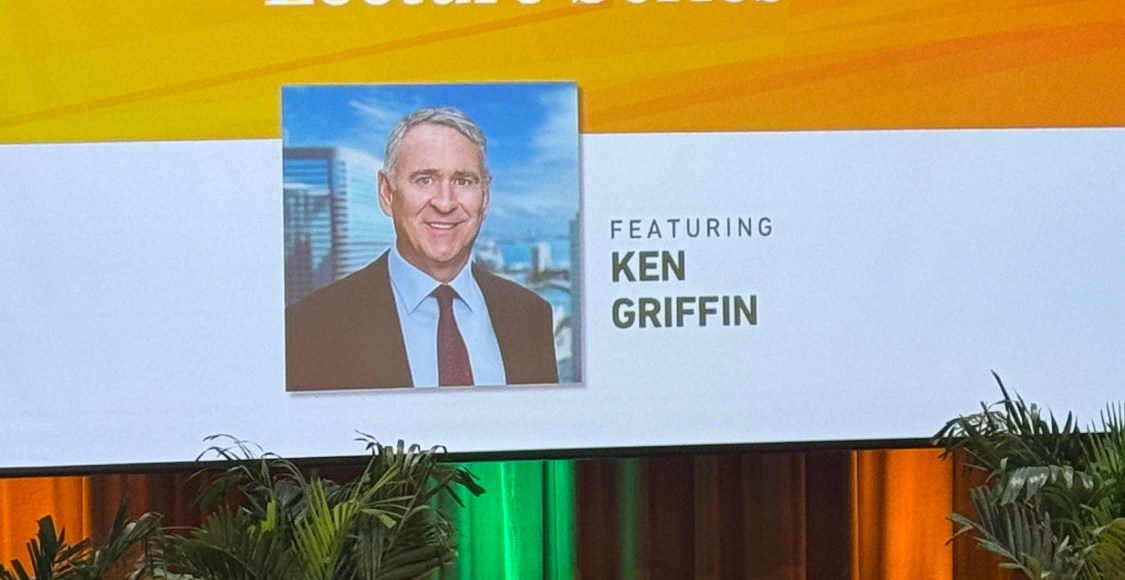

I’m Jessica de Vreeze, visual artist and Founder & President of Unchained Mothering, and I was very grateful to attend the Cobb Leadership Lecture Series at the University of Miami.
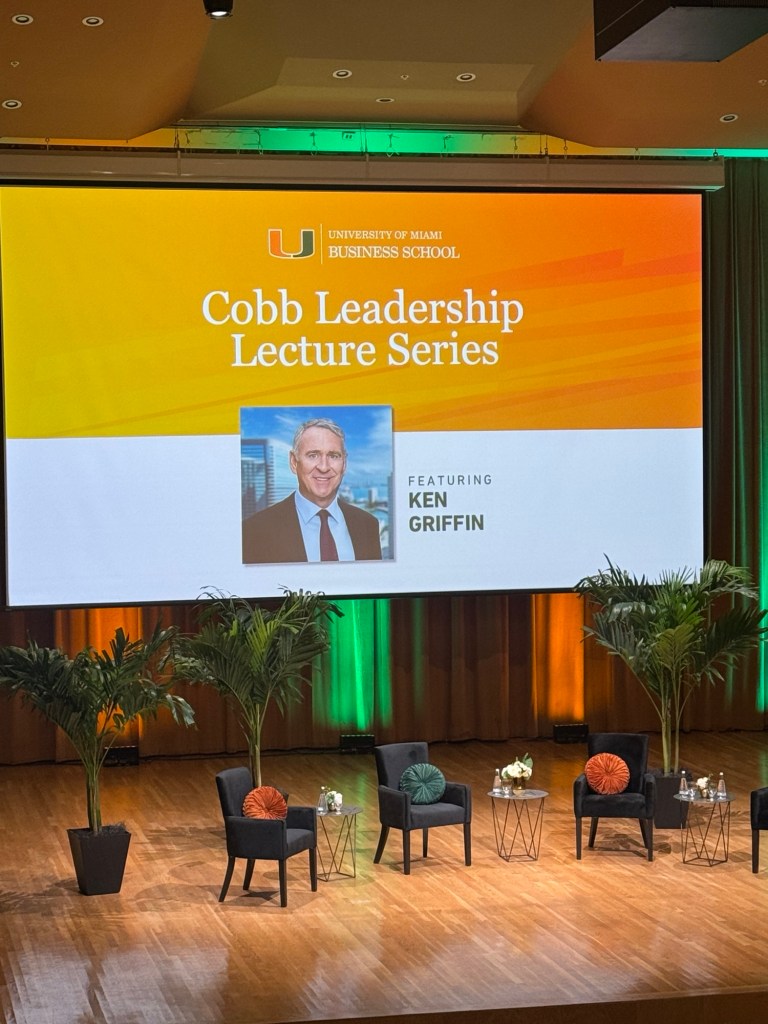
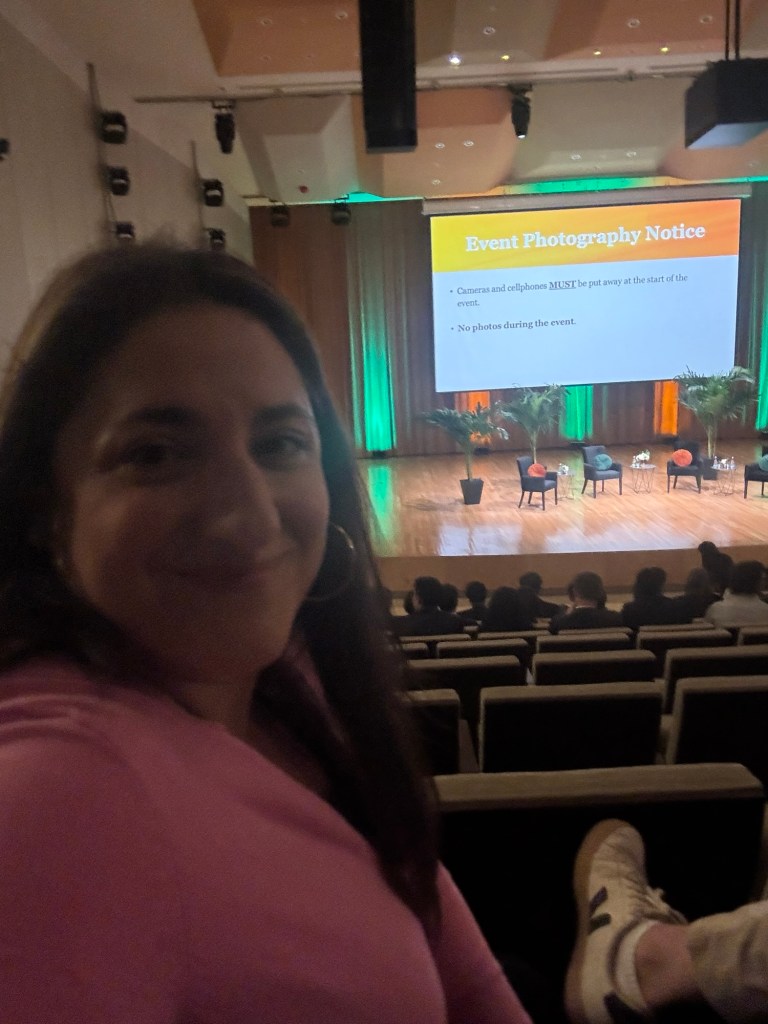
Thank you to the University of Miami for organizing such an excellent evening, and thank you, Mr. Griffin, for taking the time to speak so openly with students and the wider community. The organization was spotless from beginning to end.
I only wish I had had the opportunity to meet him personally for a moment. Since I didn’t, I thought I would do the next best thing: share what I took away from the conversation — the ideas that stayed with me about artificial intelligence, entrepreneurship, education, leadership, risk and the importance of continuing to think for ourselves.
I took notes throughout the evening and then used AI to help me organize and share them quickly — which felt particularly appropriate after a conversation so focused on how we should use AI as a tool. So here is my fast reflection while the ideas are still fresh.
And perhaps, if I am lucky, it might even find its way back to Mr. Griffin.
Mr. Griffin, if this article ever reaches you, I would be delighted to continue the conversation and introduce you to what we are building through Unchained Mothering.
Compress the distance between education and results
Earlier in the evening, Dean Paul A. Pavlou of the University of Miami Patti and Allan Herbert Business School made a point that immediately stayed with me: use AI to compress the distance between education and results.
Ambassador Charles Cobb then introduced Ken Griffin.
Griffin founded Citadel in 1990, shortly after college, and listening to him speak more than three decades later was particularly interesting because so much of the evening was about how dramatically the economic landscape has changed since he started.
He described very different economic dynamics around the world: optimism and innovation in the United States, more painful economic challenges in parts of Europe, China working to maintain strong growth, and major developments also taking place in places including India, the Middle East and Japan.
But much of the conversation came back to one enormous question:
What will AI do to our economy — and what should the next generation do about it?
From globalization to AI
Griffin described globalization as one of the enormous shifts that defined the beginning of his career.
The United States benefited tremendously from it. China was also one of globalization’s great beneficiaries.
But he argued that we did not always pay enough attention to what happened to communities in the United States when factories closed and manufacturing moved elsewhere.
Now we may be moving toward a period of greater deglobalization.
And paradoxically, AI and robotics may make it possible to bring more manufacturing back to the United States while operating with smaller, highly productive companies.
That opens extraordinary opportunities for entrepreneurs.
One of the most interesting points was that today’s economy is increasingly less constrained by the amount of capital you have.
An idea-based company may not need enormous capital to begin.
Startups can use cloud computing, AI and existing technology platforms to access capabilities that only very large companies could afford not so long ago.
AI can help with customer acquisition.
It can help entrepreneurs understand how people discover their products, what makes them buy and where the business can improve.
That dramatically changes what a small company can do.
But you still have to think
This may have been the most important message of the evening for me.
Griffin believes students need exposure to AI.
They need to understand prompting.
They need to understand what kinds of problems AI can help solve.
They need to know how to use it.
But they cannot blindly follow it.
AI can tell you something with enormous confidence — and be wrong.
Your reasoning skills therefore become even more important.
Students still need to think.
They still need to reflect.
They still need to understand how they arrived at an answer.
At Citadel, Griffin explained, they benchmark AI against things they already understand. They test it against something known before having confidence in its results.
AI can be extremely good at certain tasks. It can help with email. It can identify discrepancies. It can assist with analysis and forecasting.
But then you have to interrogate it.
Why did the model reach this conclusion?
What assumptions is it making?
What did it see that I had not thought about?
And where is it wrong?
That relationship between AI and human reasoning is much more interesting than simply asking a machine for an answer.
Humans should not become the horses
Griffin used an analogy that stayed with me.
The nightmare scenario would be a carriage in which AI is riding while human beings become the horses pulling it.
But importantly, he does not see that as the likely future — not in the coming decades, and perhaps not ever.
AI should instead be something we use to increase our capabilities.
A teammate.
Almost a cofounder.
A tool for routine tasks and analysis.
Something that can challenge our thinking.
But humans remain responsible for judgment, reasoning and direction.
We should be sitting in the carriage — not pulling it.
Learn how to learn
Perhaps the most important thing education can give students today is not one particular technical skill.
It is the ability to learn and reinvent themselves.
Technology is changing too quickly for education to end with a diploma.
Griffin spoke about the need for programs that can help people already in the middle of their careers retool themselves for their next job.
That same idea applies even more strongly to students entering the workforce today.
Be a lifelong learner.
Read.
Find mentors.
Ask questions.
Surround yourself with people who know things you don’t.
One story particularly stayed with me. Griffin described spending hours with people asking questions and learning, and then being challenged afterward about what he had actually learned.
The larger lesson was simple:
When you have the opportunity to be around people you can learn from, be the one listening — not the one listening to yourself speak.
AI will not replace human relationships
It was striking that during a conversation so focused on technology, Griffin repeatedly came back to human skills.
He looks for people who like solving problems.
But interpersonal abilities matter enormously too.
Human-to-human relationships matter.
Trust matters.
He encouraged young people to develop the more extroverted part of themselves and deliberately move outside their comfort zones.
Meet people.
Talk to people.
Learn to communicate.
Technology can replace many tasks.
Trust is much harder to replace.
And perhaps, as our technology becomes more sophisticated, our humanity becomes even more valuable.
What makes a successful entrepreneur?
Another theme I kept hearing was remarkably simple:
Solve a real problem.
Successful entrepreneurs have the right toolkit to solve the problems that exist at their particular moment in history.
That toolkit changes.
The fundamental principle does not.
Businesses have to create value for customers.
Customers then have to value what you have created enough to pay for it.
Competition pushes you to make the product or service better.
Griffin described the early Citadel years as a process of using mathematics and software, identifying what the company needed to get right — and then working relentlessly on those things.
Start with one area.
Get it right.
Then move to the next.
Successful companies meet the needs of consumers.
It sounds obvious.
But founders can very easily become distracted from it.
What is the goal?
One of my favorite parts of the conversation was Griffin’s discussion of leadership.
As a company grows, the founder has to learn to delegate.
You cannot continue doing everything yourself.
You have to learn to trust people.
You have to learn how to leverage the abilities of other people.
You also have to become better at hiring.
Understand what you are good at.
Find people who are good at what you are not.
And if you make the wrong hire, recognize it and move on.
Even today, Griffin described coming back to fundamental questions:
What is our goal in the marketplace?
Do we have the right people to make it happen?
That statement hit me.
Before adding more and more activity to a business or organization, go back to the goal.
What exactly are we trying to accomplish?
Then rewrite the plan around that goal.
What do we actually need to make it happen?
Who do we actually need?
And what can we stop doing?
Set the right level of aspiration
Griffin also talked about setting the right level of aspiration.
And then going all in.
Our world is increasingly competitive. In many fields, the best businesses can reach enormous scale.
That means having the courage to decide what you genuinely want to build — and then accepting that it may take one year, five years or ten years.
There are no guarantees.
But the aspiration itself matters.
AI may make it easier to start a company.
It does not automatically make it easier to build an exceptional one.
If everyone has access to extraordinary tools, the differentiator becomes how you use them, the quality of your judgment, the problems you decide to solve and the value you create for others.
Why Miami?
Students also asked Griffin why he ultimately chose Miami.
He described coming to South Florida during the pandemic and establishing a trading operation in Palm Beach.
What started as a response to the circumstances of the pandemic eventually led to a much larger question: why return to Chicago which was their pre pandemic location?
He spoke about his senior leadership team wanting to be in Miami, the quality of schools, the business environment, public safety, personal freedom and, perhaps most interestingly, the sense that people here speak about the future.
He sees business, technology, research and AI continuing to become increasingly important to Miami.
As someone building both an artistic career and a nonprofit organization here, that point certainly caught my attention.
Miami is still becoming.
And there is something very exciting about building in a city while the city itself is building.
Take risks when you can
When students asked what advice Griffin would give looking back at his college years, one message was very clear:
Take risks when you are young.
If you choose the wrong career, change direction.
Try something.
Fail.
Learn.
Try again.
Later in life, there may be more responsibilities and more people depending on you.
Do not squander the years when you have enormous freedom to experiment.
And here, I would add something of my own.
Do not postpone your life — or your family life — waiting for some imaginary moment when everything will finally be perfectly secure.
You can take risks, build, change careers, create and grow while raising children too — while, of course, making sure their fundamental needs are covered.
You can grow with your children.
Motherhood does not have to mark the end of ambition, experimentation or reinvention.
That is deeply connected to why I founded Unchained Mothering in the first place.
Women should not have to choose between becoming the women they want to be and becoming the mothers they want to be.
Our lives do not necessarily need to happen in perfectly separated chapters.
Sometimes we build everything together.
Sometimes it is messy.
Sometimes the plan changes.
And sometimes we grow alongside our children.
$40 trillion and the next generation
Griffin also raised a much less comfortable issue: the enormous level of U.S. government debt and the burden today’s decisions may leave to younger generations.
His language with the students was intentionally direct: their generation risks being left with a bill created by ours.
Yet his broader message was not pessimistic.
The counterweight is the extraordinary amount of innovation happening in the economy.
Technology can increase productivity.
AI can allow smaller groups of people to accomplish extraordinary things.
Ideas can become businesses with much less capital than they once required.
The question is whether we use those opportunities intelligently enough to generate the growth the next generation will need.
What I took home
I went to hear Ken Griffin speak about business, markets and AI.
What I came home thinking about was something broader.
We know we are entering an extraordinary moment, he mentioned the “golden age of AI”
AI can accelerate what we do.
It can reduce the distance between learning and execution.
It can help a tiny organization operate with capabilities that once required an enormous team.
It can help entrepreneurs build.
It can help people reinvent themselves.
But perhaps the biggest mistake would be allowing faster access to answers to weaken our ability to think.
Because the people who thrive may not simply be the people who have the fastest answers.
They may be the people who know how to ask better questions.
Who recognize when something does not make sense.
Who listen.
Who continue learning.
Who know when to delegate.
Who surround themselves with excellent people.
Who create genuine value for others.
Who develop relationships based on trust.
And who are willing to take a risk on an idea they believe matters.
I took handwritten notes during this conversation.
I then used AI to help me turn them into this article quickly.
That, in itself, feels like a very small example of the future we were discussing.
AI helped me move faster.
But the notes, the questions, the ideas that caught my attention, are my understanding, the connections to my own life and work — and what I ultimately wanted to say — remained mine.
And I think that distinction matters.
Thank you again, Mr. Griffin, Ambassador Cobb, Dean Pavlou and the University of Miami for an fast paced evening that kept the entire room fully engaged.
And Mr. Griffin — until we get a chance to meet.
Jessica de Vreeze
Founder & President | Unchained Mothering
Visual Artist
Former Avocat à la Cour — Luxembourg Bar
jessica@unchainedmothering.com
www.unchainedmothering.com
Unchained Mothering | 501(c)(3) Nonprofit Organization


0 comments on “Ken Griffin at the University of Miami: AI, Entrepreneurship, Risk — and Why Thinking for Yourself Still Matters”